
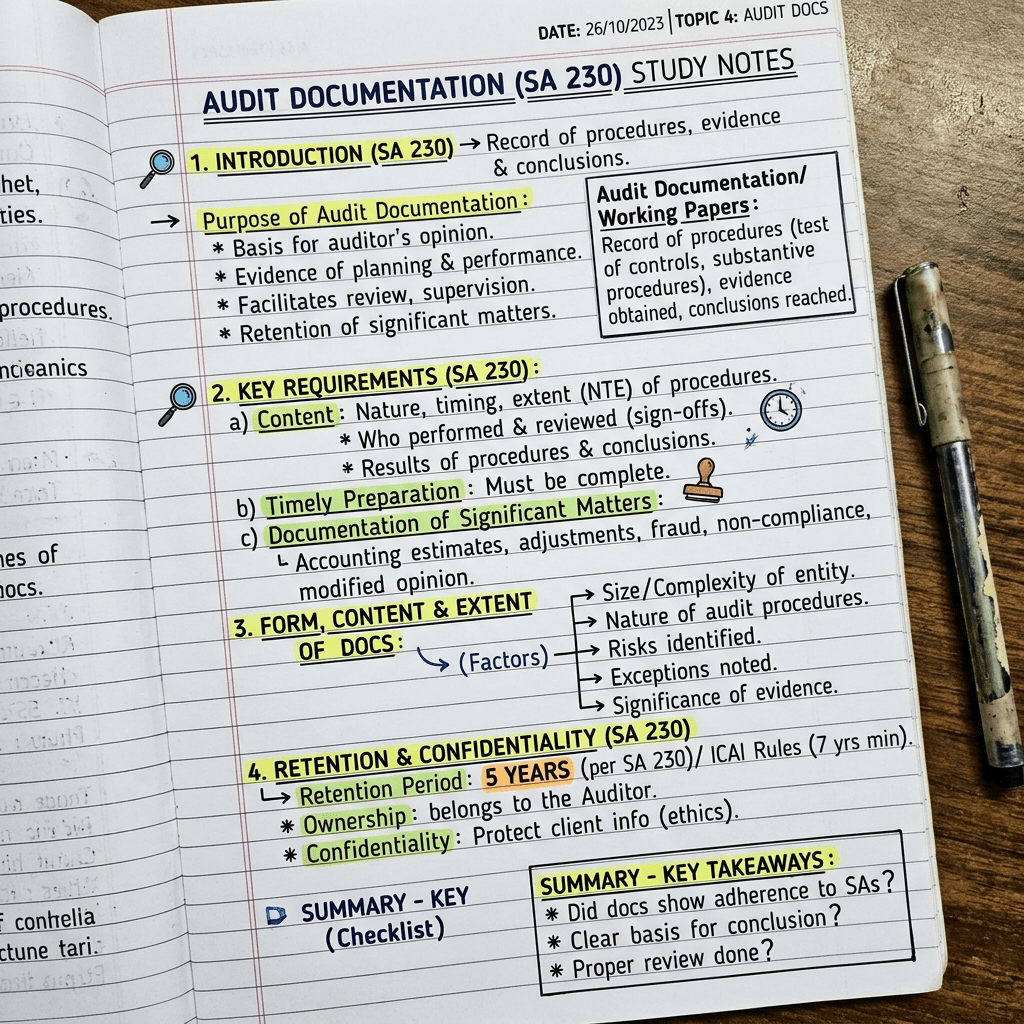
CA Inter Audit Notes – Chapter 6: Audit Documentation (SA 230)
Exam-Oriented Notes | ICAI | Quick Revision + Important Points
Chapter Overview
SA 230 – Audit Documentation
Audit Documentation means the written record of:
- Audit procedures performed
- Audit evidence obtained
- Conclusions reached by the auditor
Also known as:
- Working Papers
- Work Papers
1. Definition of Audit Documentation
Audit Documentation refers to the record of:
- Audit procedures performed
- Relevant audit evidence obtained
- Conclusions reached by the auditor
Remember:
Documentation = Procedures + Evidence + Conclusions
2. Objectives of Audit Documentation (Very Important)
The auditor should prepare documentation that provides:
(a) Basis for Auditor’s Report
A sufficient and appropriate record supporting the auditor’s opinion.
(b) Evidence of Compliance
Evidence that audit was:
- Properly planned
- Properly performed
- Conducted according to Standards on Auditing (SAs)
- Conducted according to legal requirements
Easy Mnemonic
BE
- B → Basis of Audit Report
- E → Evidence of compliance with SAs
3. Nature of Audit Documentation
Audit documentation provides evidence that:
- Auditor achieved overall audit objectives.
- Audit complied with SAs.
- Audit complied with legal and regulatory requirements.
4. Purposes of Audit Documentation (Very Important)
Audit documentation helps in:
1. Planning the audit
2. Supervising and reviewing audit work
3. Making engagement team accountable
4. Maintaining records for future audits
5. Quality Control Reviews (SQC 1)
6. External inspections by regulators
Mnemonic
PSAQER
- P – Planning
- S – Supervision
- A – Accountability
- Q – Quality Control
- E – External Inspection
- R – Record for Future Audits
5. Form, Content and Extent of Audit Documentation
Documentation should enable an experienced auditor (with no previous connection) to understand:
(a) Nature, timing and extent of audit procedures
(b) Results of audit procedures and audit evidence
(c) Significant matters
(d) Conclusions reached
(e) Professional judgments made
Auditor should record:
Identification of items tested
Person who performed audit work
Date of completion
Reviewer
Date and extent of review
Auditor should also document:
- Discussions with management
- Discussions with Those Charged with Governance (TCWG)
- Significant matters discussed
- Date of discussion
- Person with whom discussion took place
If inconsistent evidence exists
Auditor should document:
- Nature of inconsistency
- How inconsistency was resolved
6. Factors Affecting Form, Content & Extent
Depends upon:
- Size and complexity of entity
- Nature of audit procedures
- Risk of material misstatement
- Significance of audit evidence
- Nature and extent of exceptions
- Need for documenting conclusions
- Audit methodology and tools
Mnemonic
SNR SENT
- S Size
- N Nature
- R Risk
- S Significance of evidence
- E Exceptions
- N Need for conclusion
- T Tools & methodology
7. Examples of Audit Documentation
Includes:
- Audit programmes
- Analyses
- Issue memoranda
- Summary of significant matters
- Confirmation letters
- Representation letters
- Checklists
- Correspondence (including emails)
May also include:
- Contracts
- Agreements
NOT Included
Do not include:
- Superseded drafts
- Preliminary notes
- Corrected copies
- Duplicate documents
8. Timely Preparation
Documentation should be prepared:
On a timely basis
Advantages:
- Better quality
- Easier review
- Accurate documentation
- Strong audit evidence
Late preparation is less reliable.
9. Audit File
Meaning
Audit file means:
One or more folders (physical/electronic) containing audit documentation for one engagement.
10. Assembly of Final Audit File (Very Important)
The auditor should assemble audit documentation:
After the date of the auditor’s report.
Time Limit
Within 60 days
after the date of auditor’s report.
Administrative Changes Allowed
- Removing old documents
- Cross referencing
- Sorting papers
- Signing checklists
- Documenting evidence already obtained
NOT Allowed
No:
- New audit procedures
- New conclusions
11. Retention Period (Exam Favourite)
Audit documentation should be retained for:
Minimum 7 years
from:
- Auditor’s report date
OR - Group auditor’s report date (whichever is later)
12. Documentation of Significant Matters
Examples include:
- Significant risks
- Material misstatements
- Change in risk assessment
- Difficult audit procedures
- Modified opinion
- Emphasis of Matter
Professional Judgment should also be documented
Examples:
- Basis of important conclusions
- Reasonableness of estimates
- Authenticity of documents
13. Completion Memorandum (Audit Documentation Summary)
Contains:
- Significant matters identified
- How those matters were resolved
Benefits:
- Easy review
- Easy inspection
- Helpful in large audits
- Helps ensure compliance with all SAs
14. Ownership of Audit Documentation (Very Important)
Audit documentation belongs to:
Auditor
NOT the client.
Auditor may provide extracts to client if:
- It does not affect audit quality.
- Independence is not impaired.
Important Time Limits
| Particular | Time |
|---|---|
| Assemble Final Audit File | Within 60 days |
| Retention Period | Minimum 7 years |
Important Exam Points
✔ SA Applicable → SA 230
✔ Working Papers = Audit Documentation
✔ Property of → Auditor
✔ Audit File → Physical/Electronic records
✔ Timely preparation improves audit quality
✔ No new audit procedures after report date
✔ Final audit file within 60 days
✔ Retention period = 7 years
Mnemonics for Revision
Objectives
BE
- B → Basis of Report
- E → Evidence of Compliance
Purpose
PSAQER
- Planning
- Supervision
- Accountability
- Quality Control
- External Inspection
- Record for Future Audits
Factors Affecting Documentation
SNR SENT
- Size
- Nature
- Risk
- Significance
- Exceptions
- Need for conclusion
- Tools
ICAI Exam Questions Frequently Asked
- Define Audit Documentation.
- Objectives of Audit Documentation.
- Purposes of Audit Documentation.
- Factors affecting form, content and extent.
- Examples of Audit Documentation.
- Explain Audit File.
- Assembly of Final Audit File.
- Time limit for assembly (60 days).
- Retention period (7 years).
- Ownership of Audit Documentation.
- Completion Memorandum.
- Documentation of Significant Matters.
One-Page Revision Sheet
- SA: 230
- Meaning: Procedures + Evidence + Conclusions
- Objectives: Basis of report + Evidence of compliance
- Purposes: Planning, Supervision, Accountability, Future audits, QC, Inspection
- Documentation Includes: Audit programme, Analyses, Checklists, Confirmation, Representation letters, Emails
- Audit File: Physical/Electronic folders of audit documentation
- Final File Assembly: Within 60 days
- Retention: 7 years
- Ownership: Auditor
- No new audit procedures after audit report
- Completion Memorandum: Significant matters + Resolution
 School of Law & Auditing
Leave a comment