
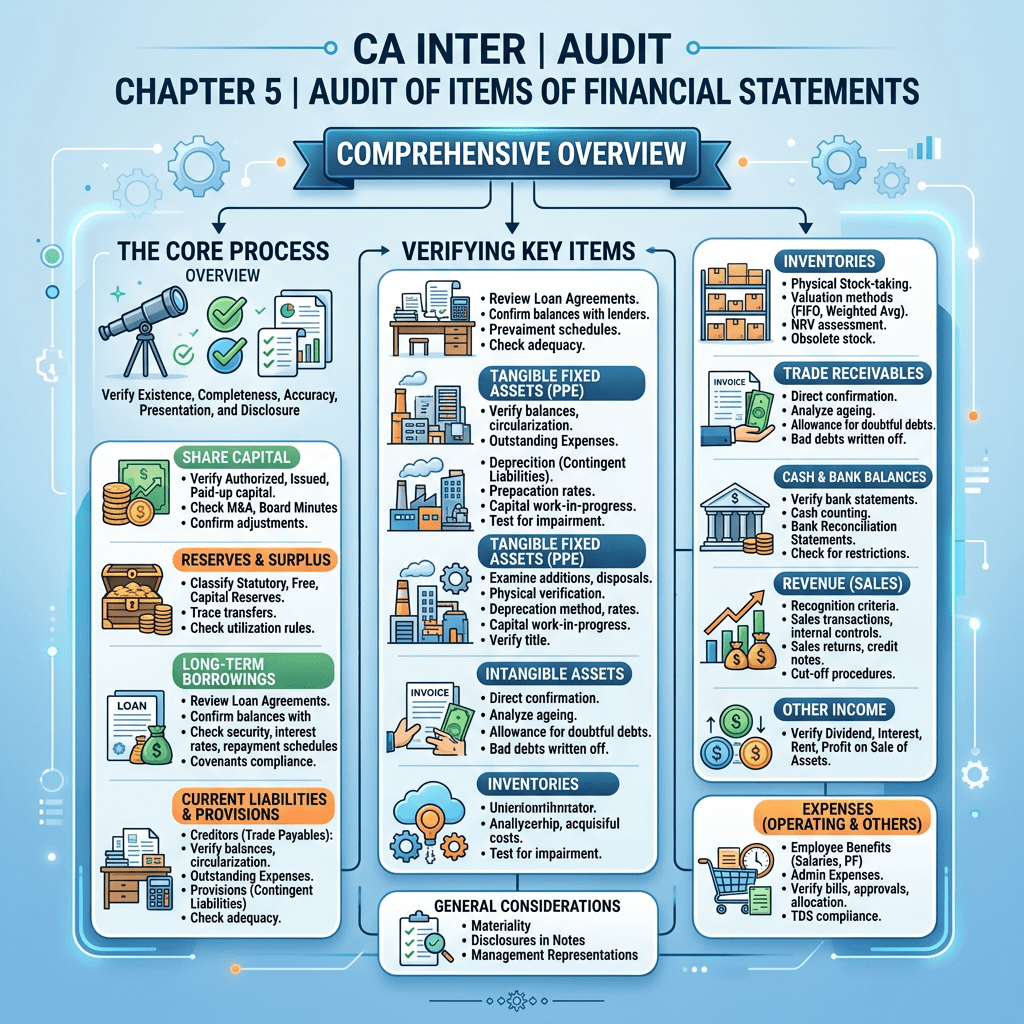
CA Inter Audit & Ethics Notes
Chapter 5 – Audit of Items of Financial Statements
Part 2 – Audit of Reserves & Surplus and Borrowings
3.2 AUDIT OF RESERVES & SURPLUS
Meaning of Reserves
Reserves are appropriations of profits that are not intended to meet any known liability, contingency, commitment or diminution in value of assets.
They strengthen the financial position of the company and provide internal financing.
Types of Reserves
A. Revenue Reserve
Created out of operating profits.
Purpose
- Distribution of dividend
- Business expansion
- Increase working capital
- Meet lean years
- Strengthen financial position
Examples
- General Reserve
- Retained Earnings
B. Capital Reserve
Created out of capital profits.
Not available for dividend.
Examples
- Profit on sale of fixed assets
- Profit on sale of investments
- Securities Premium
- Capital Redemption Reserve
Important Point
Capital Reserve can generally be used for:
- Writing off capital losses
- Writing off fictitious assets
- Bonus issue (if realised)
However,
Securities Premium and Capital Redemption Reserve can be utilised only for purposes specified in the Companies Act, 2013.
Assertions Covered
- Existence
- Completeness
- Valuation
- Presentation & Disclosure
Audit Procedures
A. Existence
Auditor should
✔ Trace opening balance with previous year’s audited financial statements.
✔ Verify additions and utilisations during the year.
Profit & Loss Balance
Verify:
- Movement in Statement of Profit & Loss
- Statement of Changes in Equity
- Board Resolution recommending dividend
- Shareholders’ Resolution approving dividend
Important Exam Point
AS 4 (Revised) / Ind AS 10
Dividend declared after Balance Sheet Date
➡ Not recognised as liability
Only disclosed in Notes to Accounts.
Exam Favourite
Securities Premium
Verify:
- Shares issued above face value
- Board Resolution
- Transfer to Securities Premium Account
Ensure utilisation is only as permitted under Section 52.
Valuation
Auditor ensures:
- Reserve balances correctly computed.
- Movements correctly recorded.
- Securities Premium not misused.
Presentation & Disclosure
Schedule III requires classification into:
- Capital Reserve
- Capital Redemption Reserve
- Securities Premium
- Debenture Redemption Reserve
- Revaluation Reserve
- Share Options Outstanding Account
- Other Reserves
- Surplus
Important Disclosure
For every reserve:
Show
- Opening Balance
- Additions
- Deductions
- Closing Balance
Debit Balance of P&L
Shown as negative Surplus.
Remember
Reserve represented by earmarked investments is called a
Fund
Example:
- Sinking Fund
Quick Revision Table
| Assertion | Audit Procedure |
|---|---|
| Existence | Compare opening balances |
| Completeness | Verify additions & utilisation |
| Valuation | Check computation |
| Disclosure | Schedule III compliance |
3.3 AUDIT OF BORROWINGS
Meaning
Borrowings are funds obtained from external sources.
Examples
- Bank Loan
- Cash Credit
- Debentures
- Public Deposits
- Term Loan
- Financial Institutions
Why Important?
If liabilities are:
- omitted
- understated
- overstated
Financial Statements will not show a True & Fair View.
Assertions Covered
- Existence
- Completeness
- Valuation
- Presentation & Disclosure
A. Existence
Auditor should verify
Board Approval
Check Board Minutes for
- New loans
- Debentures
- Lending agreements
Loan Agreement
Verify
- Interest Rate
- Repayment Terms
- Security
- Borrowing Limits
Balance Confirmation
Obtain direct confirmation from
- Banks
- Financial Institutions
(SA 505)
Hire Purchase
Verify agreement.
Debentures
Check Trust Deed for
- Redemption
- Interest
- Covenants
- Restrictions
Loan Repaid
Ensure
Charge on assets has been released.
Written Representation
Obtain representation from Management that
All liabilities recorded are genuine.
B. Completeness
Auditor should obtain
Schedule of
- Long-term Borrowings
- Short-term Borrowings
containing
- Opening Balance
- Fresh Loans
- Repayment
- Closing Balance
Verify
Compare closing balances with General Ledger.
Review
Subsequent transactions after year-end
Purpose
To detect
Unrecorded Liabilities
Direct Confirmation
Obtain confirmation from lenders.
Verify
- Interest Rate
- Security
- Due Date
- Outstanding Balance
If no reply
Perform alternative procedures
Example
- Examine bank statements
- Loan agreements
- Payment records
C. Valuation
Auditor should verify
Accounting Policy
Consistently followed.
Interest
Recalculate interest.
Premium / Discount
Recompute amortisation.
Foreign Currency Loan
Restate as per
AS 11
Loan Covenants
Verify compliance.
If breached,
Check whether loan becomes Current Liability.
If waiver received,
Obtain lender confirmation.
Classification
Verify
Long-term vs Short-term.
Current Maturity
Installments due within next 12 months
Must be separately disclosed.
Restrictive Covenants
Verify proper disclosure.
Registration of Charges
Verify charge created and registered with ROC.
Security Value
If security value is less than loan,
Loan secured only to the extent of security.
Related Party Loans
Verify compliance with
- AS 18
- Ind AS 24
Bills Discounted
Ensure proper disclosure.
Borrowing Powers
Check
- MOA
- AOA
Companies Act Compliance
Verify compliance with
- Section 180 – Restrictions on Board Powers
- Section 185 – Loans to Directors
- Section 186 – Loans & Investments
Purpose Test
Ensure
Loan used only for authorised business purposes.
Public Deposits
Verify RBI directions.
D. Presentation & Disclosure
Long-term Borrowings
Classify into
- Debentures
- Term Loans
- Deferred Payment Liabilities
- Deposits
- Related Party Loans
- Finance Lease Obligations
- Other Loans
Further Classification
- Secured
- Unsecured
Nature of security must be disclosed.
Also disclose
- Director Guarantee
- Interest Rate
- Redemption Terms
- Repayment Terms
- Defaults
- Current Maturity
Short-term Borrowings
Disclose
- Demand Loans
- Related Party Loans
- Deposits
- Other Loans
Separate
- Secured
- Unsecured
Additional Regulatory Information
1. Borrowings against Current Assets
Company must disclose
Whether quarterly statements submitted to banks agree with books.
If not,
Provide reconciliation.
2. Wilful Defaulter
Disclose
- Date
- Nature of default
- Amount
3. Charges pending Registration
Disclose
Reasons and details.
4. Utilisation of Borrowed Funds
If money routed through intermediaries,
Company must disclose
- Date
- Amount
- Ultimate Beneficiary
- FEMA compliance
- PMLA compliance
Exam Case
Cash Credit ₹2 Crore
Secured by
- Stock
- Debtors
Guaranteed by Directors.
Disclosure
Short-term Borrowings
↓
Secured Loan
↓
Nature of Security
↓
Director Guarantee
↓
Default (if any)
One-Day Revision
Reserves
✔ Revenue Reserve
✔ Capital Reserve
✔ Securities Premium
✔ Dividend after BS Date → Only Disclosure
✔ Schedule III
Borrowings
Verify
✔ Board Resolution
✔ Loan Agreement
✔ Bank Confirmation
✔ Interest
✔ Loan Covenants
✔ Foreign Currency Loan
✔ ROC Charge
✔ Sections 180, 185, 186
✔ Schedule III Disclosure
✔ Additional Regulatory Information
Important Sections for Exam
| Section | Topic |
|---|---|
| 52 | Securities Premium |
| 180 | Restriction on Board Powers |
| 185 | Loans to Directors |
| 186 | Loans & Investments |
| SA 505 | External Confirmations |
| AS 11 | Foreign Currency Borrowings |
| AS 4 / Ind AS 10 | Dividend after Balance Sheet Date |
Memory Mnemonics
Audit of Borrowings (E-C-V-D)
E → Existence (Board, Loan Agreement, Confirmation)
C → Completeness (Loan Schedule, Subsequent Events)
V → Valuation (Interest, AS 11, Covenants)
D → Disclosure (Schedule III, Charges, Defaults)
Part 2 covers approximately pages 24–37 of the chapter. The next part will cover Trade Receivables and Cash & Cash Equivalents, which are among the most important topics for ICAI examinations.
 School of Law & Auditing
Leave a comment