
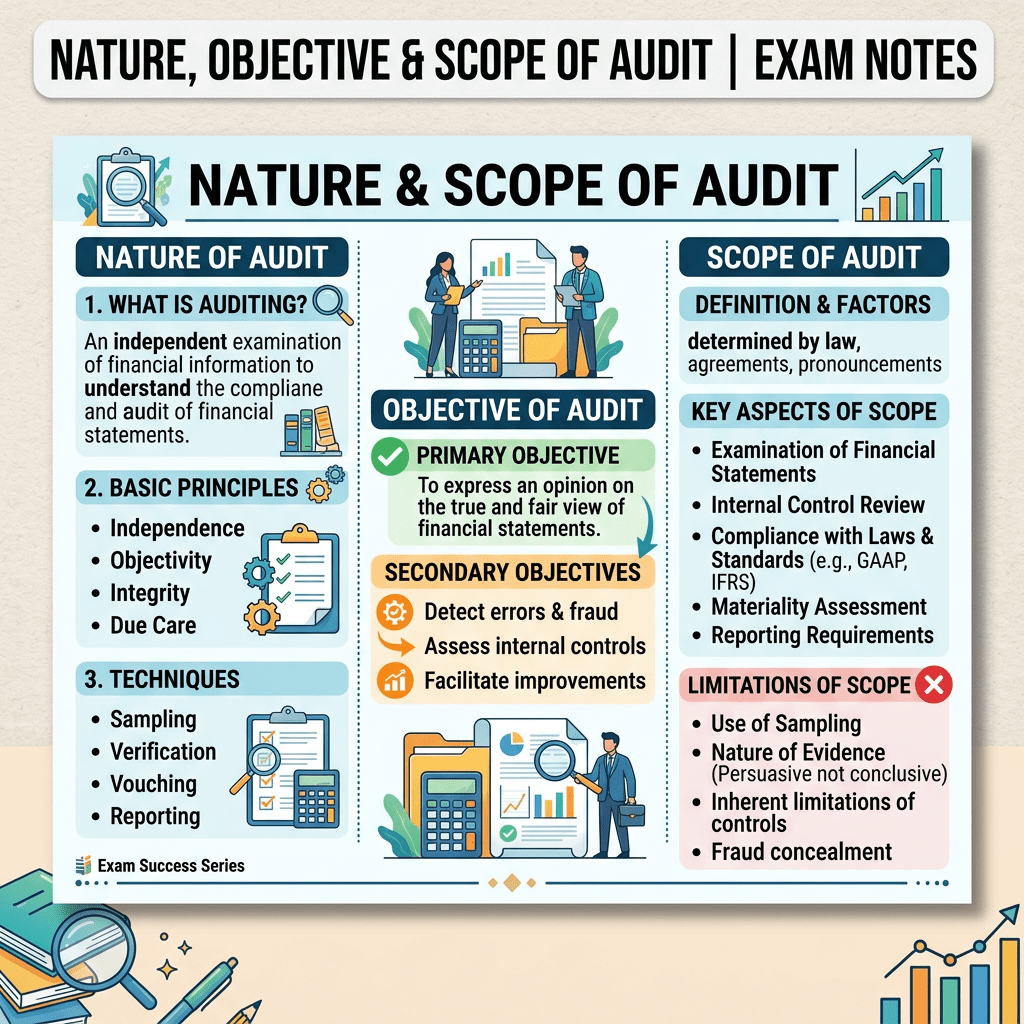
Lesson 1: Nature, Objective and Scope of Audit – Exam Notes
1. Meaning of Audit
Definition:
“An audit is an independent examination of financial information of any entity, whether profit-oriented or not, irrespective of size or legal form, conducted with a view to expressing an opinion thereon.”
Key Features
- Independent Examination
- Auditor must be free from influence.
- Independence ensures objectivity.
- Examination of Financial Information
- Includes financial statements and accounting records.
- Applicable to Any Entity
- Company, LLP, Partnership, Trust, NGO, Society, etc.
- Purpose: Expression of Opinion
- Auditor gives opinion through audit report.
2. Nature of Audit
Audit Provides Assurance
- Audit increases confidence of users in financial statements.
- It provides reasonable assurance, not absolute assurance.
Responsibilities
| Management | Auditor |
|---|---|
| Preparation of Financial Statements | Expression of Opinion |
| Maintenance of Books | Verification & Reporting |
3. Origin of Auditing
Historical Background
- References found in Kautilya’s Arthashastra (4th Century BC).
- Word Audit derived from Latin word “Audire” meaning “To Hear”.
- ICAI established in 1949 for regulating Chartered Accountancy profession in India.
4. Interdisciplinary Nature of Auditing
Auditing is linked with several subjects:
(a) Accounting
- Audit reviews accounting records and financial statements.
(b) Law
- Knowledge of Companies Act, Tax Laws, etc.
(c) Economics
- Understanding economic environment.
(d) Behavioural Science
- Interaction with management and employees.
(e) Statistics & Mathematics
- Sampling techniques.
(f) Data Processing
- EDP/Computerized Auditing.
(g) Financial Management
- Ratio Analysis
- Working Capital
- Funds Flow
(h) Production
- Understanding business operations.
5. Objectives of Audit (SA 200)
Primary Objectives
1. Obtain Reasonable Assurance
Financial statements are free from material misstatements caused by:
- Fraud
- Error
2. Express an Opinion
Whether financial statements are prepared in accordance with the applicable financial reporting framework.
3. Report Findings
Issue audit report and communicate findings.
Reasonable Assurance vs Absolute Assurance
| Reasonable Assurance | Absolute Assurance |
|---|---|
| High level assurance | Complete guarantee |
| Audit provides this | Audit cannot provide this |
Exam Point: Audit provides High but not 100% assurance.
6. Scope of Audit
What Audit Includes
1. Coverage of All Relevant Aspects
Audit should be planned to cover all significant areas.
2. Reliability and Sufficiency of Information
Auditor evaluates:
- Books of account
- Vouchers
- Bills
- Documents
3. Proper Disclosure
Ensures:
- Proper classification
- Adequate disclosure
- Compliance with Accounting Standards and Law
4. Expression of Opinion
Final outcome is audit report.
What Audit Does NOT Include
Auditor is NOT:
❌ Engineer
❌ Valuation expert for technical assets
❌ Expert in authentication of documents
❌ Investigator
Audit vs Investigation
| Audit | Investigation |
|---|---|
| General purpose | Specific purpose |
| Broad scope | Narrow scope |
| Reasonable assurance | Detailed examination |
7. Inherent Limitations of Audit
Because of these limitations, audit cannot provide absolute assurance.
(1) Nature of Financial Reporting
- Management judgments involved.
- Internal controls may fail.
(2) Nature of Audit Procedures
- Sample checking.
- Auditor cannot verify every transaction.
- Possibility of fake documents.
- Management may conceal fraud.
(3) Audit is not Investigation
- No search powers.
- No power to record statements on oath.
(4) Timeliness Constraint
- Information loses relevance over time.
(5) Future Events
- Future uncertainties cannot be predicted.
Mnemonic:
FNITF
- F – Financial Reporting
- N – Nature of Procedures
- I – Investigation (Not)
- T – Timeliness
- F – Future Events
8. Engagement
Meaning
An arrangement under which auditor agrees to provide services to a client.
Engagement Letter
Formal agreement between auditor and client.
9. Benefits of Audit
Advantages
- High-quality financial information.
- Safeguards shareholders’ interests.
- Moral check on employees.
- Helps tax authorities.
- Assists lenders and banks.
- Detects frauds and errors.
- Identifies control weaknesses.
10. Audit – Mandatory or Voluntary?
Mandatory Audit
Examples:
- Companies Act Audit
- Tax Audit
Voluntary Audit
Done because of benefits and stakeholder confidence.
11. Appointment of Auditor
Generally Appointed By:
- Owners
- Shareholders
- Partners
- Government authorities (where applicable)
Company Auditor
Appointed by shareholders in AGM.
Government Company Auditor
Appointed by the Comptroller and Auditor General of India (CAG).
12. Audit Report
Submitted To
The person who appoints the auditor.
Examples:
- Company → Shareholders
- Firm → Partners
13. Assurance Engagement
Meaning
An engagement where a practitioner provides a conclusion to increase users’ confidence in information.
Elements of Assurance Engagement
5 Elements
- Three-party relationship
- Appropriate subject matter
- Suitable criteria
- Sufficient appropriate evidence
- Written assurance report
Mnemonic:
TPSEW
- T = Three Party Relationship
- P = Proper Subject Matter
- S = Suitable Criteria
- E = Evidence
- W = Written Report
14. Audit vs Review
| Basis | Audit | Review |
|---|---|---|
| Assurance | Reasonable | Limited |
| Level | High | Moderate |
| Procedures | Extensive | Fewer |
| Example | Statutory Audit | Interim Review |
15. Types of Assurance Engagements
(A) Reasonable Assurance Engagement
Example:
- Audit of Financial Statements
(B) Limited Assurance Engagement
Example:
- Review of Financial Statements
(C) Other Assurance Engagements
Examples:
- Prospective Financial Information
- Internal Control Reports
16. Qualities of an Auditor
Important Qualities
- Integrity
- Independence
- Tact
- Patience
- Judgement
- Reliability
- Professional Competence
- Knowledge of Accounting
- Clear-headedness
17. Engagement Standards
Types
1. Standards on Auditing (SA)
Audit of historical financial information.
Examples:
- SA 200
- SA 230
- SA 315
- SA 500
- SA 700
2. Standards on Review Engagements (SRE)
Examples:
- SRE 2400
- SRE 2410
3. Standards on Assurance Engagements (SAE)
Examples:
- SAE 3400
- SAE 3420
4. Standards on Related Services (SRS)
Examples:
- SRS 4400
- SRS 4410
18. Standards on Quality Control (SQC)
SQC 1
Purpose:
- Ensure compliance with professional standards.
- Ensure quality control within firms.
- Ensure appropriate reports are issued.
19. Why Standards Are Needed?
- Global benchmarks.
- Improve reporting quality.
- Promote uniformity.
- Enhance professional skills.
- Ensure audit quality.
Exam Quick Revision
Definition of Audit
Independent examination of financial information to express an opinion.
Audit Provides
✅ Reasonable Assurance
Audit Does NOT Provide
❌ Absolute Assurance
Objectives of Audit
- Reasonable assurance
- Express opinion
- Report findings
Inherent Limitations
FNITF
- Financial reporting
- Nature of procedures
- Investigation (not)
- Timeliness
- Future events
Elements of Assurance Engagement
TPSEW
- Three-party relationship
- Proper subject matter
- Suitable criteria
- Evidence
- Written report
Engagement Standards
SA + SRE + SAE + SRS
Quality Control Standard
SQC 1
Most Important SA for Chapter 1
SA 200 – Overall Objectives of the Independent Auditor and Conduct of Audit
 School of Law & Auditing
Leave a comment