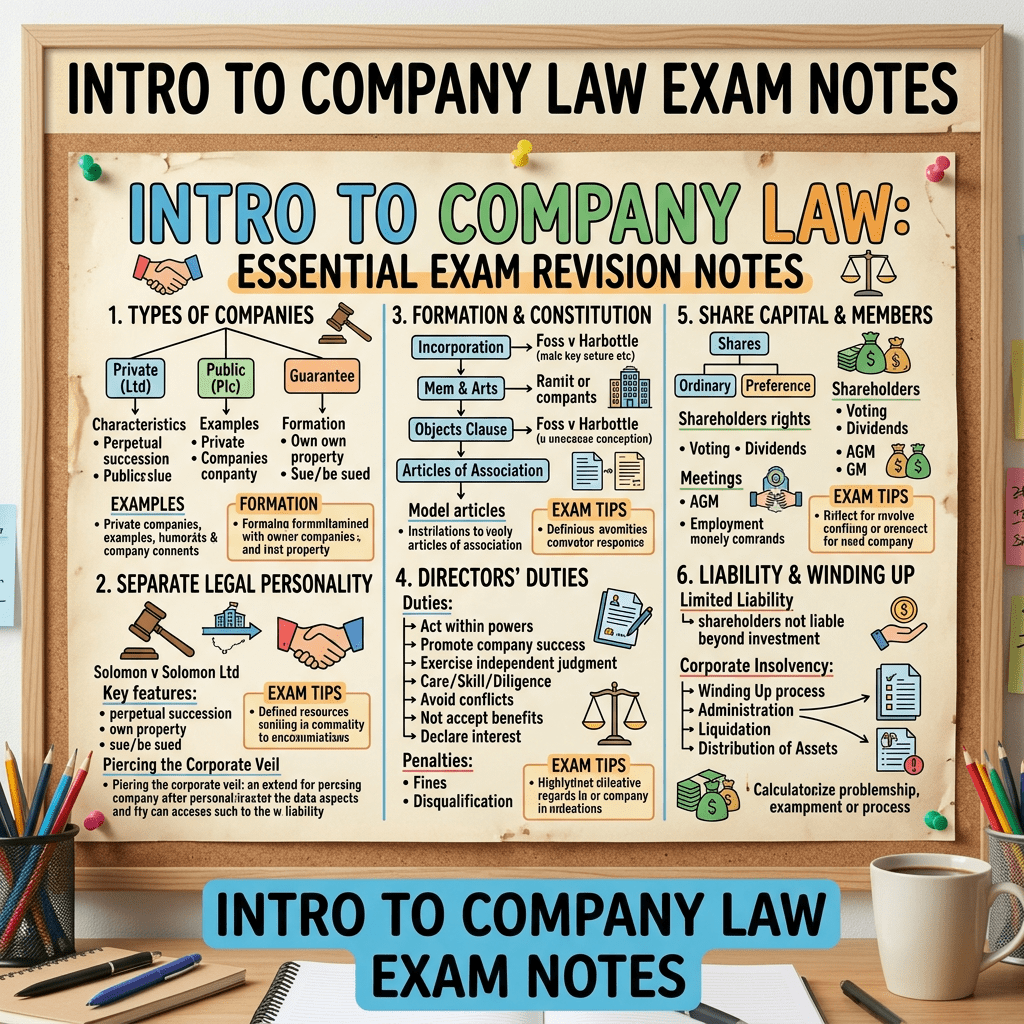
Lesson 1: Introduction to Company Law – Exam Notes
1. Introduction to Company Law
- Company Law in India is largely based on English Company Law.
- First Companies Act in India: 1850.
- Present law: Companies Act, 2013.
- Companies Act, 2013 received Presidential assent on 29 August 2013 and was notified on 30 August 2013.
2. Evolution of Company Law in India
| Act | Key Feature |
|---|---|
| Joint Stock Companies Act, 1850 | Registration of companies |
| Act, 1857 | Introduced Limited Liability Companies |
| Act, 1860 | Banking & Insurance companies allowed limited liability |
| Act, 1866 | Comprehensive law for incorporation and winding up |
| Companies Act, 1913 | Introduced Private Companies |
| Companies Act, 1956 | Based on Bhabha Committee Report |
| Companies Act, 2013 | Transparency, accountability, corporate governance |
3. Features of Companies Act, 2013
New Concepts Introduced
- One Person Company (OPC)
- Small Company
- Dormant Company
- Independent Director
- Woman Director
- Secretarial Audit
- Class Action Suits
- Registered Valuers
- Vigil Mechanism
- CSR (Corporate Social Responsibility)
- E-Voting
4. Doctrine of Ultra Vires
Meaning
“Ultra Vires” means Beyond Powers.
Any act beyond:
- Companies Act
- Memorandum of Association (MOA)
- Articles of Association (AOA)
is Ultra Vires.
Types of Ultra Vires
A. Ultra Vires the Companies Act
Acts contrary to Companies Act.
Example:
- Illegal reduction of share capital.
- Dividend paid out of capital.
B. Ultra Vires the Memorandum (MOA)
Acts beyond Objects Clause.
C. Ultra Vires the Articles (AOA)
Acts beyond Articles but within MOA.
These may be ratified after altering Articles by Special Resolution.
Important Case Laws
Ashbury Railway Carriage Co. Ltd. v. Riche (1878)
- Landmark case on Ultra Vires.
- Contract beyond object clause held void.
- Shareholders cannot ratify such acts.
A. Lakshmanaswami Mudaliar v. LIC
- Donations must have connection with company’s business.
- Pure charitable spending beyond company objects is ultra vires.
Effects of Ultra Vires Acts
- Void ab initio.
- Members can seek injunction.
- Directors may become personally liable.
- Company can recover property acquired through ultra vires acts.
- Ultra vires borrowing creates no debtor-creditor relationship.
5. Doctrine of Indoor Management
Meaning
Protects outsiders dealing with the company.
Outsiders may assume:
- Internal procedures have been properly followed.
- Necessary approvals have been obtained.
Known as Turquand Rule.
Landmark Case
Royal British Bank v. Turquand
Outsider was entitled to assume that company resolutions were properly passed.
Principle: Outsiders need not investigate internal management.
Exceptions to Indoor Management
- Knowledge of irregularity.
- No knowledge of MOA & AOA.
- Forgery.
- Negligence.
- No actual agency exists.
- Act is ultra vires the company itself.
6. Doctrine of Constructive Notice
Meaning
Everyone dealing with a company is presumed to know:
- Memorandum of Association
- Articles of Association
because these are public documents.
Effect
A person cannot claim ignorance of restrictions contained in MOA or AOA.
Important Case
Kotla Venkataswamy v. Rammurthy
Mortgage deed was invalid because articles required additional signatures.
Outsider deemed to know articles.
7. Doctrine of Alter Ego
Meaning
“Alter Ego” = “Other Self”
Court may treat:
- Company
- Directors
- Shareholders
as one entity where fraud or misuse exists.
Important Case
Sunil Bharti Mittal v. CBI
Supreme Court clarified that directors cannot automatically be made criminally liable merely because they control the company.
8. Lifting / Piercing the Corporate Veil
Meaning
Court ignores separate legal personality of company and identifies real persons behind it.
When Veil is Lifted?
- Fraud
- Tax Evasion
- Agency Relationship
- Public Policy
- Avoidance of Welfare Laws
- Criminal Activities
- Improper Conduct
Important Cases
Jones v. Lipman
Company used to avoid contractual liability → Veil lifted.
Re Sir Dinshaw Maneckjee Petit
Company formed only to avoid tax → Veil lifted.
Vodafone International Holdings v. Union of India
Supreme Court refused to lift veil as transaction was genuine.
Kapila Hingorani v. State of Bihar
State held responsible despite PSU’s separate personality.
9. Applicability of Companies Act, 2013
Applies to:
- Companies incorporated under this Act.
- Banking companies.
- Insurance companies.
- Electricity companies.
- Government companies.
- Other statutory corporations.
Does not apply to unincorporated associations.
10. Types of Definitions
Restrictive Definition
Uses word “Means”
- Exhaustive definition.
Extensive Definition
Uses word “Includes”
- Enlarges meaning.
11. Important Definitions under Companies Act, 2013
Company
Company incorporated under Companies Act.
Company Limited by Shares
Liability limited to unpaid amount on shares.
Company Limited by Guarantee
Liability limited to guaranteed amount.
Holding Company
Company controlling subsidiary company.
Subsidiary Company
Holding company:
- Controls Board OR
- Controls more than 50% voting power.
Public Company
Not a private company.
Private Company
- Restricts share transfer.
- Maximum 200 members.
- Cannot invite public to subscribe.
One Person Company (OPC)
Company having only one member.
Small Company
Paid-up capital ≤ ₹4 crore and turnover ≤ ₹40 crore.
Government Company
At least 51% capital held by Government.
Foreign Company
Company incorporated outside India but doing business in India.
Dormant Company
Inactive company formed for future project/asset holding.
Nidhi Company
Promotes savings and lending among members.
Listed Company
Company whose securities are listed on recognized stock exchange.
12. Key Managerial Personnel (KMP)
Includes:
- CEO / MD / Manager
- Company Secretary
- Whole-Time Director
- CFO
- Other officers designated by Board
Quick Revision (Most Important Exam Topics)
✅ Ultra Vires Doctrine
✅ Indoor Management (Turquand Rule)
✅ Constructive Notice
✅ Alter Ego Doctrine
✅ Lifting of Corporate Veil
✅ OPC, Small Company, Government Company
✅ Holding & Subsidiary Company
✅ Important Case Laws:
- Ashbury Railway v. Riche
- Royal British Bank v. Turquand
- Jones v. Lipman
- Vodafone Case
- Sunil Bharti Mittal v. CBI
 School of Law & Auditing
Leave a comment