
Lesson 1: Sources of Law – Exam Notes
1. Meaning of Law
- Law is a set of rules made by a competent authority to regulate human conduct and maintain order in society.
- Under Article 13(3) of the Constitution of India, “Law” includes:
- Ordinance
- Order
- Bye-law
- Rule
- Regulation
- Notification
- Custom or Usage having force of law.
Definitions by Jurists
| Jurist | Definition |
|---|---|
| Ulpian | Law is the art/science of what is equitable and good |
| Cicero | Law is the highest reason implanted in nature |
| Justinian | Law is the standard of what is just and unjust |
2. Significance of Law
- Maintains peace and social order.
- Ensures justice and security.
- Acts as an instrument of social change.
- Promotes socio-economic justice.
- Adapts according to changing social conditions.
3. Jurisprudence
Meaning
- Derived from:
- Juris = Law
- Prudence = Knowledge
- Jurisprudence = Science or philosophy of law.
Major Views
- Analytical Jurisprudence – studies law logically.
- Sociological Jurisprudence – studies law in relation to society.
- Teleological Jurisprudence – studies the purpose of law.
Salmond’s View
Jurisprudence = Science of the first principles of civil law.
4. Legal Theory
Positive Legal Theory
- Explains what law is.
Normative Legal Theory
- Explains what law ought to be.
5. Important Jurists and Their Theories
A. Jeremy Bentham
Theory
- Pioneer of Analytical Jurisprudence.
- Law = Command of Sovereign.
- Based on Principle of Utility:
- Maximum happiness of maximum people.
Features of Law
- Source
- Subjects
- Objects
- Extent
- Aspects
- Force
- Remedial Appendage
- Expression
Criticism
- Ignores customs.
- Ignores judge-made laws.
- Pleasure-pain test is subjective.
- Does not explain power-conferring laws.
B. John Austin – Command Theory
Law = Command of Sovereign backed by Sanction
Essentials
- Command
- Sovereign
- Sanction
Criticism
- Cannot explain welfare laws.
- Ignores international law.
- Ignores judge-made laws.
- Sovereign is limited by Constitution today.
C. Salmond
Definition
Law = Body of principles recognized and applied by courts in administration of justice.
Main Idea
- Purpose of law = Administration of Justice.
Criticism
- Justice is not the only purpose of law.
- Unjust laws also exist.
D. Roscoe Pound – Social Engineering Theory
Objective
Create an efficient society by balancing competing interests.
Types of Interests
Individual Interests
- Personality
- Domestic relations
- Property
Public Interests
- Interests of State
Social Interests
- Security
- Morality
- Social institutions
- Progress
- Individual welfare
Criticism
- No clear method to evaluate interests.
- Gives excessive importance to judiciary.
E. H.L.A. Hart
Positivism
- Law and morality are separate.
- Law should be studied independently from ethics.
F. Hans Kelsen – Pure Theory of Law
Law
- A system of norms.
Grundnorm (Basic Norm)
- Highest norm from which all laws derive validity.
Hierarchy
- Grundnorm
- Superior Norms
- Subordinate Norms
Criticism
- Difficult to identify Grundnorm.
- International law does not fit well into theory.
6. Schools of Law
1. Natural School
Law based on morality and reason.
Theories
- Ancient
- Medieval
- Renaissance
- Modern
Key Thinkers
- Socrates
- Plato
- Aristotle
- Thomas Aquinas
- Hugo Grotius
- Immanuel Kant
- Stammler
2. Analytical School
Exponents
- John Austin
- Hans Kelsen
Main Idea
- Law as it is, not as it ought to be.
- Also called Positivist School.
3. Historical School
Exponents
- Savigny
- Henry Maine
Main Idea
- Law develops from customs and traditions.
- Law is found, not made.
- Source = Volksgeist (Spirit of the People).
4. Philosophical/Ethical School
- Law and ethics are interconnected.
- Law should promote justice and morality.
5. Sociological School
Exponents
- Duguit
- Ihering
- Roscoe Pound
Main Idea
- Law is a social institution.
- Focuses on relationship between law and society.
6. Realist School
Exponents
- Holmes
- Cardozo
Main Idea
- Law is what courts actually do.
- Focus on judicial decisions.
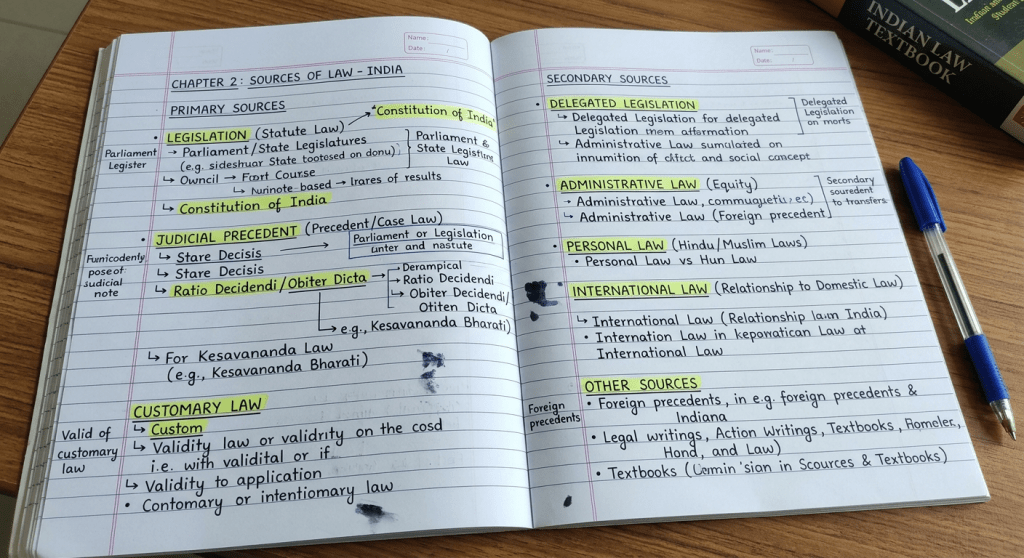
7. Sources of Indian Law
Primary Sources
1. Customs
Oldest source of law.
Types
A. Customs without sanction
- Positive morality.
B. Customs with sanction
- Legal Customs
- Local Customs
- General Customs
- Conventional Customs (Usages)
Essentials of Valid Custom
- Immemorial
- Certainty
- Reasonableness
- Continuous observance
- Conformity with law and morality
- Unanimity
- Peaceable enjoyment
- Consistency
2. Judicial Precedents
Meaning:
- Previous judicial decisions followed in similar cases.
Doctrine of Stare Decisis
- “Let the decision stand.”
- Similar cases should be decided similarly.
Types
- Declaratory
- Original
- Persuasive
- Absolutely Authoritative
- Conditionally Authoritative
Ratio Decidendi
- Binding principle of a judgment.
Obiter Dicta
- Remarks made by the judge.
- Persuasive only.
3. Statutes / Legislation
Types
Supreme Legislation
- Parliament
- Constitutional authority
Subordinate (Delegated) Legislation
- Executive rules
- Municipal bye-laws
- University regulations.
4. Personal Laws
Hindu Law Sources
- Vedas (Shruti)
- Smritis
- Commentaries
- Customs
Muslim Law Sources
- Quran
- Hadis
- Ijma
- Qiyas
- Commentaries (Hedaya, Fatawa Alamgiri)
8. Secondary Sources of Indian Law
Justice, Equity and Good Conscience
Applied when:
- No statute
- No custom
- No personal law exists.
Sources of English Law
- Common Law
- Law Merchant
- Equity
- Statute Law
One-Page Revision (Most Important Exam Points)
✅ Article 13(3) – Definition of Law
✅ Bentham – Utility Theory
✅ Austin – Command Theory (Command + Sovereign + Sanction)
✅ Salmond – Law = Administration of Justice
✅ Roscoe Pound – Social Engineering
✅ Kelsen – Pure Theory & Grundnorm
✅ Schools of Law:
- Natural
- Analytical
- Historical
- Philosophical
- Sociological
- Realist
✅ Primary Sources:
- Customs
- Precedents
- Legislation
- Personal Laws
✅ Valid Custom – 8 essentials
✅ Doctrine of Stare Decisis
✅ Ratio Decidendi vs Obiter Dicta
✅ Secondary Sources:
- Justice, Equity & Good Conscience
- English Law Sources
These notes are suitable for LLB (JIGL) exam revision and can be revised in about 20–30 minutes before the exam.
 School of Law & Auditing
Leave a comment